Elaborating a New Vision for America: Lessons from John Brown and the Present Crisis
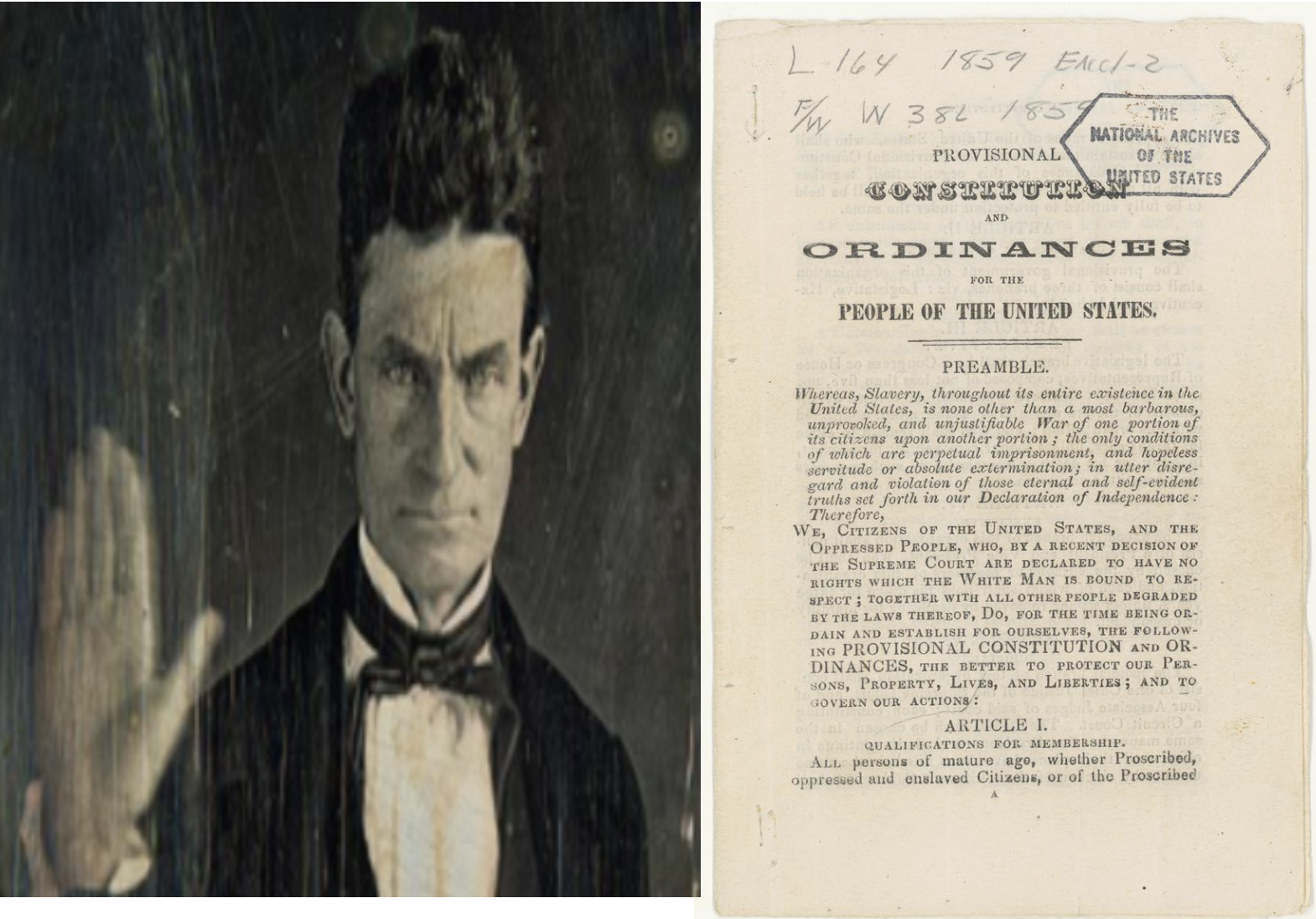
Abolitionist John Brown/ Brown’s constitution (1858)
The United States stands at a precipice. Our institutions—government, economy, education, and public trust—have fractured under the weight of inequality, political corruption, and systemic failures. Yet, even in this bleak moment, the idea of America, the promise of a just and democratic society, remains unfulfilled but intact. To move forward, we must reimagine and construct a vision that does not merely reform the current system but rebuilds it from the foundation up.
A Historical Parallel: John Brown’s Provisional Constitution and Its Legacy
In the 1850s, amidst the growing tensions over slavery, John Brown, an abolitionist insurgent, crafted his own Provisional Constitution. It was not just an ideological exercise—it was a direct challenge to the legitimacy of the United States government as it stood, which he and his allies saw as irredeemably compromised by its complicity in slavery. Brown’s constitution laid out a framework for a new governance model—one rooted in democracy, justice, and human dignity. It was a revolutionary document not because it was utopian, but because it was practical, offering a structural alternative to the U.S. Constitution of his time, which protected slavery and oligarchy.
Brown’s vision and ultimate martyrdom at Harpers Ferry in 1859 shocked the nation. While he was executed as a radical, his death became a moral catalyst that reshaped the political and legal order of the United States. His unwavering commitment to abolition forced the North to reconsider its moral and constitutional obligations, paving the way for the Republican Party’s more aggressive stance against slavery. His sacrifice directly influenced the radical rethinking of governance that would eventually manifest in Reconstruction—a period where, for the first time, the Constitution was fundamentally rewritten to expand the definition of citizenship, civil rights, and democracy itself.
The Reconstruction Amendments (13th, 14th, and 15th) were, in many ways, the realization of Brown’s moral vision: the abolition of slavery, the guarantee of equal protection under the law, and the expansion of voting rights to Black Americans. The Civil Rights movements of the 20th century, too, drew from this radical reinterpretation of America’s founding documents. Today, we need this same moral force—a clear, uncompromising demand for justice that does not accept half-measures or incremental reform.
The Failures of Our Current Institutions
While Brown’s time was defined by slavery, ours is defined by a different kind of subjugation:
Corporate Rule & Economic Exploitation: The consolidation of wealth and power has turned our government into an instrument of the ultra-rich, where billionaires write policy, and workers are treated as disposable.
A Broken Electoral System: Voter suppression, gerrymandering, the Electoral College, and the influence of money in politics have turned elections into a game rigged against the working class.
Police & Carceral State: The U.S. prison-industrial complex and militarized police forces are modern enforcers of racial and class oppression, much as slave patrols were in Brown’s time.
Climate Injustice & Environmental Destruction: Just as the antebellum economy depended on slavery, our modern capitalist economy is dependent on the destruction of the planet—and the poorest bear the brunt of the crisis.
The Erosion of Public Education & Media: A misinformed, disengaged public is easier to manipulate. Education has been defunded, and media conglomerates stifle dissent and independent thought.
Yet, despite these systemic failures, the idea of America as a true democratic society still lingers as an unrealized promise. We must fight not just to critique these structures, but to build alternatives.
Building Towards a New Vision
If Brown and his allies were willing to defy the U.S. government in order to fight for a higher moral truth, what must we do today? What institutions can we build, and what frameworks can we develop to push America toward the democracy it has never fully realized?
A New Political Economy – We must transition from capitalism’s predatory nature to a system that prioritizes economic democracy—worker cooperatives, public banking, and universal basic needs like housing and healthcare.
A People’s Constitution – Just as Brown sought to write a new constitutional order free from the moral corruption of slavery, we need a new constitutional framework that recognizes economic rights, environmental justice, and a participatory democracy beyond the two-party system.
Democratic Control Over Industry & Media – Corporations currently control the media and means of production. We need a nationalized, worker-led economic structure and publicly owned media institutions that serve people, not profits.
Direct Action & Community Power – Change has never come from the halls of Congress alone. It comes from unions, mutual aid networks, tenant councils, and direct community control over resources.
Abolition of the Carceral State – Brown sought to dismantle the legal frameworks that upheld slavery. We must do the same with the prison-industrial complex and police forces that continue to uphold racial and class oppression.
Ecological Reconstruction – Just as slavery was the economic backbone of the 19th century, fossil fuel dependence is the foundation of today’s destruction. A Green New Deal must not just be a reform—it must be a worker-led reconstruction of how we organize energy, land use, and economic systems.
Sources of Guidance & Action
Historical Precedents: Brown’s Provisional Constitution, Reconstruction-era Black-led governance, the 1930s labor movements, and Civil Rights-era organizing all provide blueprints for resistance and structural alternatives.
Modern Thinkers & Movements: Scholars and activists like Keeanga-Yamahtta Taylor, Naomi Klein, Cornel West, and Richard Wolff offer frameworks for socialist, ecological, and racial justice-oriented governance.
International Models: Latin American labor movements, participatory budgeting models in Brazil, and democratic socialism in Nordic nations provide real-world templates for alternative governance.
Grassroots Movements Today: Democratic Socialists of America (DSA), labor unions, Black-led abolitionist movements, and indigenous sovereignty struggles are already laying the groundwork for a radically different America.
Biographical Insight: John Brown’s America: The Fighter, The Martyr, and the Struggle for Righteousness by David S. Reynolds (2020) offers a crucial modern reassessment of Brown’s radicalism and its long-term impact on American democracy.
Conclusion: A Call to Action
John Brown was not just reacting to the injustice of his time—he was offering an alternative vision when none seemed possible. His death forced a radical rethinking of American democracy, leading to Reconstruction and, eventually, the Civil Rights movement.
Today, we need that same force of moral clarity. The current system is beyond repair—it must be replaced. This is not a time for minor reforms or symbolic gestures. It is a time to articulate, build, and fight for the institutions that will serve a truly just and democratic society. The vision of America has never been fully realized—but it does not have to remain a myth. It can become a reality if we are willing to do what Brown and so many others have done before: demand something new.